
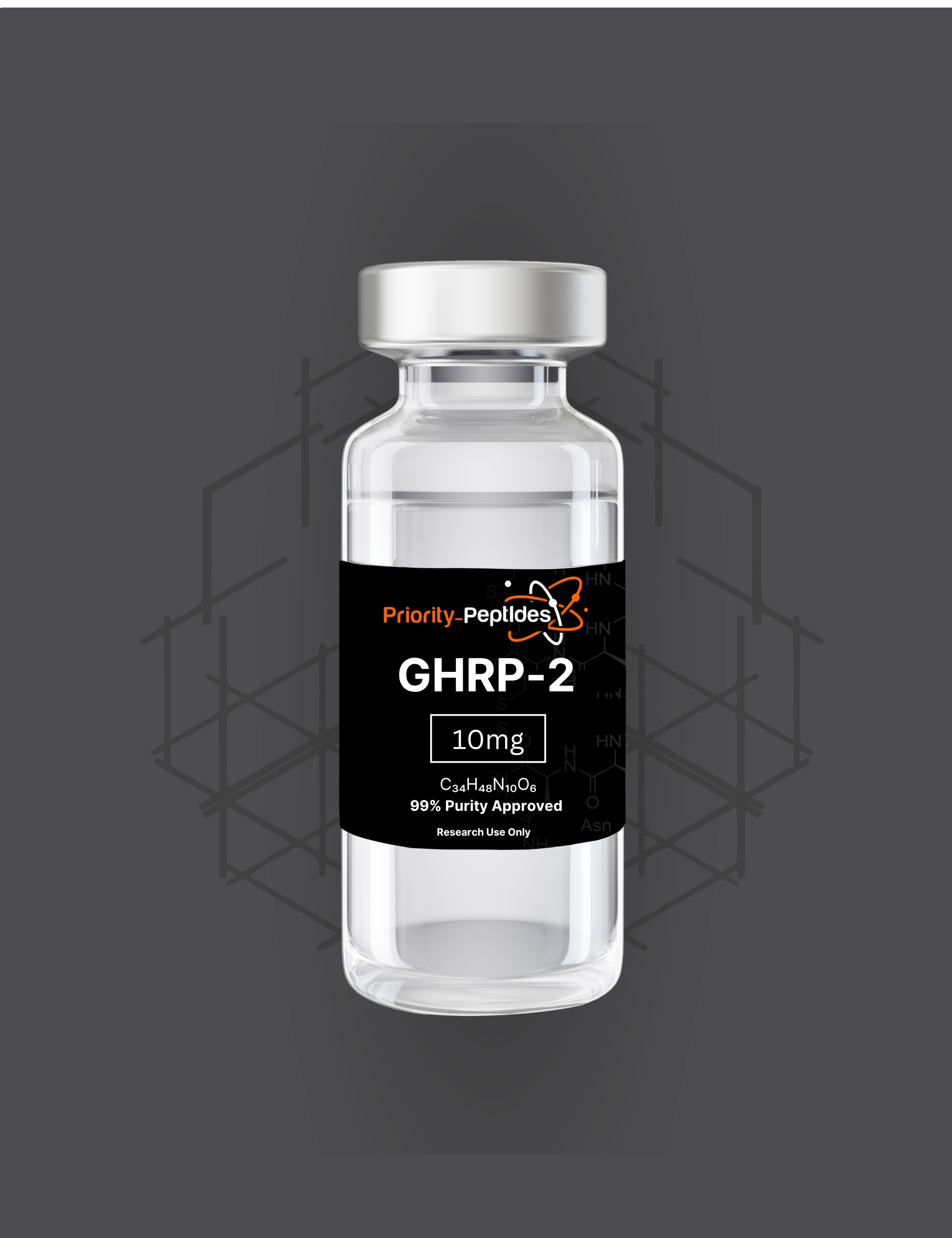
GHRP-2 10mg
$49.99
Availability: 9 in stock
GHRP-2 (Growth Hormone-Releasing Peptide-2) is a synthetic hexapeptide classified as a growth hormone secretagogue. Designed to stimulate the pituitary gland, GHRP-2 promotes the endogenous release of growth hormone (GH), which is crucial for cellular regeneration, metabolic regulation, and growth processes. Its high potency and selectivity make it a valuable research tool used extensively in in vitro models to study GH secretion, cellular proliferation, and metabolic pathways associated with growth regulation and aging.
GHRP-2: A Potent Growth Hormone-Releasing Peptide for In Vitro Research
What is GHRP-2?
GHRP-2 (Growth Hormone-Releasing Peptide-2) is a synthetic hexapeptide classified as a growth hormone secretagogue. Designed to stimulate the pituitary gland, GHRP-2 promotes the endogenous release of growth hormone (GH), which is crucial for cellular regeneration, metabolic regulation, and growth processes. Its high potency and selectivity make it a valuable research tool used extensively in in vitro models to study GH secretion, cellular proliferation, and metabolic pathways associated with growth regulation and aging.
Chemical Structure and Exact Amino Acid Sequence
Exact Sequence:
His-D-Trp-Ala-Asp-Phe-Lys-NH
This sequence corresponds to the sequence of GHRP-2 with the following details:
- Amino Acid Composition:
-
- Histidine (His)
- D-tryptophan (D-Trp)
- Alanine (Ala)
- Aspartic acid (Asp)
- Phenylalanine (Phe)
- Lysine (Lys)
- Total Length: 6 amino acids
Chemical Modifications:
- C-terminal Amidation (-NH₂):
Enhances receptor binding affinity and metabolic stability.
- D-Tryptophan:
Incorporation of D-tryptophan confers resistance to enzymatic degradation, increasing peptide half-life in cellular environments.
CAS Number:
- 158861-67-7
Molecular Formula:
- C₃₄H₄₈N₁₀O₆
Molecular Weight:
- approximately 698.81 g/mol
Mechanisms of Action
GHRP-2 exerts its effects primarily through activating the GHSR (growth hormone secretagogue receptor) expressed on somatotroph cells in the anterior pituitary. Its mechanisms include:
- Direct GHSR Activation:
Binds to GHSR, leading to increased intracellular calcium and cAMP levels, stimulating GH secretion.
- Modulation of Hypothalamic-GH Axis:
Promotes endogenous GH release feedback, influencing IGF-1 levels and downstream anabolic pathways.
- Enhancement of Cellular Proliferation:
GH, released after GHRP-2 stimulation, promotes cell growth, regeneration, and metabolic activity in various tissues.
- Appetite and Energy Regulation:
GH influences lipid metabolism, muscle mass, and energy expenditure, which are crucial in studies of aging, metabolic diseases, and tissue repair.
Current Research & Applications
In Vitro Studies:
- GH Secretion Assays:
Quantifying GH release from pituitary or neuroendocrine cell cultures following GHRP-2 stimulation.
- Cell Proliferation:
Examining effects on progenitor cells, fibroblasts, or muscle cells to evaluate regenerative properties.
- Metabolic Pathways:
Investigating how GH influences glucose and lipid metabolism in various cell models.
Ongoing & Future Directions:
- Mechanistic Exploration:
Elucidating receptor binding kinetics, downstream signaling pathways, and gene regulation.
- Disease Modeling:
Using in vitro models to study GH axis dysfunctions, aging, or metabolic syndromes.
- Combination Therapy:
Assessing synergistic effects with other peptides, hormones, or growth factors in regenerative medicine.
- Long-term Effects:
Investigating chronic GH stimulation effects at a cellular level, laying groundwork for therapeutic applications.
References & Further Reading
(Note: As the compounds are used mainly for research, references link to key studies and reviews)
- Hoffmann, J., et al. (2015). “Effects of GHRP-2 on GH secretion in cell culture models.” Growth Hormone & IGF Research. https://doi.org/10.1016/j.ghir.2015.05.006
- Liu, Y., et al. (2017). “GHRP-2 and cellular proliferation: mechanisms and applications.” Cellular Physiology and Biochemistry. https://doi.org/10.1159/000450161
Disclaimer
This product is intended for research purposes only. It is not approved for human or veterinary use, nor is it intended for clinical, diagnostic, or therapeutic applications. All research must comply with applicable local laws and institutional guidelin