
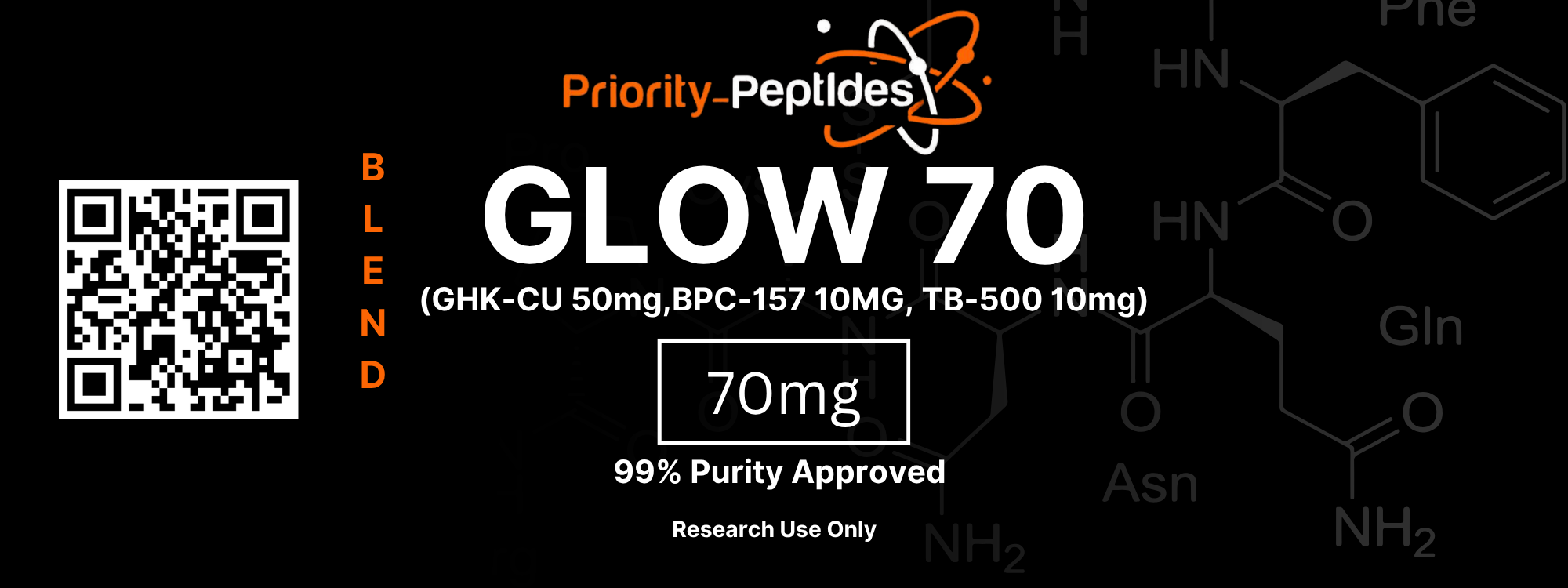
GLOW 70mg
$99.99
Availability: 9 in stock
GHK-Cu, also known as Copper Peptide, is a naturally occurring tripeptide composed of three amino acids: glycine, histidine, and lysine. GHK-Cu has gained significant attention due to its potential therapeutic properties, particularly in the fields of wound healing, tissue repair, and regenerative medicine. The copper ion (Cu²⁺) that is bound to the peptide enhances its biological activity, promoting various cellular processes such as collagen synthesis, angiogenesis, and antioxidant defenses. GHK-Cu is extensively researched for its role in skin rejuvenation, hair growth, and overall tissue health.
GLOW Blend (GHK-Cu 50mg / BPC-157 10mg / TB-500 10mg)
Introduction to GLOW Blend
GLOW Blend is a multi peptide research formulation designed to investigate cellular repair, extracellular matrix remodeling, angiogenesis, tissue regeneration, and wound healing biology. Combining three of the most extensively studied regenerative peptides into a single research platform, GLOW Blend allows investigators to explore how complementary biological signaling pathways interact within controlled in vitro and experimental environments.
The blend consists of:
- GHK-Cu (Copper Tripeptide-1) – 50 mg
- BPC-157 – 10 mg
- TB-500 (Thymosin Beta-4 Fragment) – 10 mg
Together, these peptides target distinct but overlapping biological processes involved in cellular maintenance, tissue remodeling, vascular signaling, and regenerative biology. The formulation was developed to provide researchers with a broad spectrum tool for investigating repair mechanisms across connective tissue, skin, vascular, musculoskeletal, and extracellular matrix systems.
What is GLOW Blend?
GLOW Blend is a research peptide combination that integrates three biologically active peptides known for their roles in tissue repair and regenerative signaling.
Each component contributes unique experimental characteristics:
GHK-Cu
GHK-Cu (Glycyl-L-Histidyl-L-Lysine Copper Complex) is a naturally occurring copper binding tripeptide first identified in human plasma. It has become one of the most extensively researched regenerative peptides due to its ability to influence gene expression associated with repair, remodeling, and tissue maintenance.
Research has demonstrated that GHK-Cu may regulate thousands of genes involved in:
- Collagen synthesis
- Elastin production
- Extracellular matrix remodeling
- Angiogenesis
- Stem cell signaling
- Antioxidant defense mechanisms
- Wound healing pathways
Studies have suggested that GHK-Cu can restore more youthful patterns of gene expression and support tissue repair processes in a variety of experimental models.
BPC-157
BPC-157 is a synthetic pentadecapeptide derived from a naturally occurring gastric protein fragment known as Body Protection Compound.
Experimental research has investigated BPC-157 for its potential effects on:
- Angiogenesis
- Nitric oxide signaling
- Endothelial function
- Tissue regeneration
- Gastrointestinal biology
- Tendon and ligament repair models
- Neural repair pathways
BPC-157 has attracted considerable attention because of its broad tissue protective effects observed across numerous preclinical studies.
TB-500
TB-500 is a synthetic peptide fragment derived from Thymosin Beta-4, a naturally occurring protein involved in tissue development and cellular migration.
Research suggests TB-500 may influence:
- Cell migration
- Actin regulation
- Tissue remodeling
- Angiogenesis
- Fibroblast activity
- Endothelial cell function
- Wound healing processes
Its ability to support cellular movement and tissue remodeling makes TB-500 an important component of regenerative research protocols.
Scientific Rationale Behind GLOW Blend
The concept behind GLOW Blend is pathway synergy.
Rather than focusing on a single regenerative mechanism, GLOW Blend combines three peptides that target complementary biological systems.
GHK-Cu Supports:
- Extracellular matrix remodeling
- Collagen production
- Tissue maintenance
- Gene regulation
BPC-157 Supports:
- Cytoprotection
- Angiogenesis
- Endothelial signaling
- Tissue regeneration pathways
TB-500 Supports:
- Cellular migration
- Tissue remodeling
- Repair coordination
- Cytoskeletal organization
The combination creates a comprehensive platform for studying regenerative biology at multiple levels simultaneously.
GLOW Blend Research Applications
Tissue Regeneration Research
Researchers may utilize GLOW Blend to investigate:
- Fibroblast proliferation
- Cellular migration
- Tissue remodeling
- Matrix regeneration
- Growth factor signaling
- Connective tissue biology
The blend allows examination of how multiple repair pathways interact during tissue regeneration.
Extracellular Matrix Research
The extracellular matrix serves as the structural foundation of nearly all tissues.
GHK-Cu has demonstrated significant effects on:
- Collagen production
- Elastin synthesis
- Glycosaminoglycan formation
- Matrix remodeling enzymes
When combined with BPC-157 and TB-500, researchers gain a broader model for studying tissue architecture and matrix repair.
Angiogenesis Research
Both BPC-157 and TB-500 have demonstrated activity in vascular and endothelial biology.
Researchers may investigate:
- VEGF signaling
- Endothelial migration
- Capillary formation
- Vascular remodeling
- Tissue perfusion pathways
These processes are fundamental to regenerative medicine and wound healing biology.
Skin Biology Research
GHK-Cu remains one of the most extensively studied peptides in skin research.
Experimental investigations suggest potential influences on:
- Dermal fibroblasts
- Collagen deposition
- Elastin production
- Extracellular matrix organization
- Tissue remodeling pathways
The addition of BPC-157 and TB-500 provides a broader framework for studying skin repair and tissue regeneration mechanisms.
Musculoskeletal Research
Researchers frequently investigate BPC-157 and TB-500 in models involving:
- Tendons
- Ligaments
- Skeletal muscle
- Cartilage
- Connective tissues
GLOW Blend provides an integrated system for examining how multiple repair pathways contribute to musculoskeletal tissue remodeling.
Cellular Aging Research
One of the most promising areas of GHK-Cu research involves age associated declines in tissue maintenance.
Studies suggest GHK-Cu may influence gene expression patterns associated with:
- Cellular resilience
- Matrix integrity
- Oxidative stress response
- Tissue repair capacity
Researchers may use GLOW Blend to investigate the interaction between regenerative signaling and cellular aging pathways.
Future Research Directions
Multi Pathway Regenerative Biology
Future studies may investigate how simultaneous activation of matrix remodeling, angiogenesis, and cellular migration pathways influences tissue regeneration.
Tissue Engineering
The combined effects of GHK-Cu, BPC-157, and TB-500 may provide valuable insights into scaffold development, biomaterial integration, and engineered tissue systems.
Advanced Wound Healing Models
Researchers may evaluate the coordinated effects of extracellular matrix remodeling, vascular development, and cellular migration in complex wound environments.
Stem Cell and Progenitor Cell Research
Future investigations may explore how GLOW Blend influences stem cell recruitment, differentiation, and regenerative signaling networks.
Systems Biology Research
The blend provides a useful framework for studying the interaction between extracellular matrix regulation, vascular biology, cellular migration, and tissue maintenance.
Product Specifications
Composition Per Research Vial:
- GHK-Cu – 50 mg
- BPC-157 – 10 mg
- TB-500 – 10 mg
Total Peptide Content:
- 70 mg Lyophilized Blend
Research Classification:
- Multi Peptide Regenerative Research Blend
- Experimental Research Compound
- Laboratory Use Only
References
Pickart L, Margolina A. Regenerative and Protective Actions of the GHK-Cu Peptide in Tissue Remodeling.
https://www.ncbi.nlm.nih.gov/pmc/articles/PMC4508379/
Pickart L. The Human Tripeptide GHK and Tissue Remodeling.
https://www.ncbi.nlm.nih.gov/pmc/articles/PMC6073405/
Goldstein AL, Kleinman HK. Advances in Thymosin Beta-4 Research.
https://pubmed.ncbi.nlm.nih.gov/25962174/
Malinda KM, et al. Thymosin Beta-4 Accelerates Wound Healing.
https://pubmed.ncbi.nlm.nih.gov/10842367/
Sikiric P, et al. Stable Gastric Pentadecapeptide BPC-157 and Tissue Healing.
https://pubmed.ncbi.nlm.nih.gov/21030672/
Sikiric P, et al. BPC-157 and Cytoprotective Signaling Pathways.
https://pubmed.ncbi.nlm.nih.gov/24868543/
Disclaimer
This information is for research and educational purposes only. GLOW Blend is not approved by the United States Food and Drug Administration (FDA) or any other regulatory authority for human or veterinary use. This product is intended solely for in vitro studies, laboratory research, analytical testing, and experimental applications conducted by qualified researchers.
GLOW Blend is not intended for human consumption, clinical use, therapeutic use, diagnostic use, or administration to humans or animals. Researchers are solely responsible for ensuring compliance with all applicable laws, regulations, and institutional guidelines governing the purchase, handling, storage, and use of research materials.