
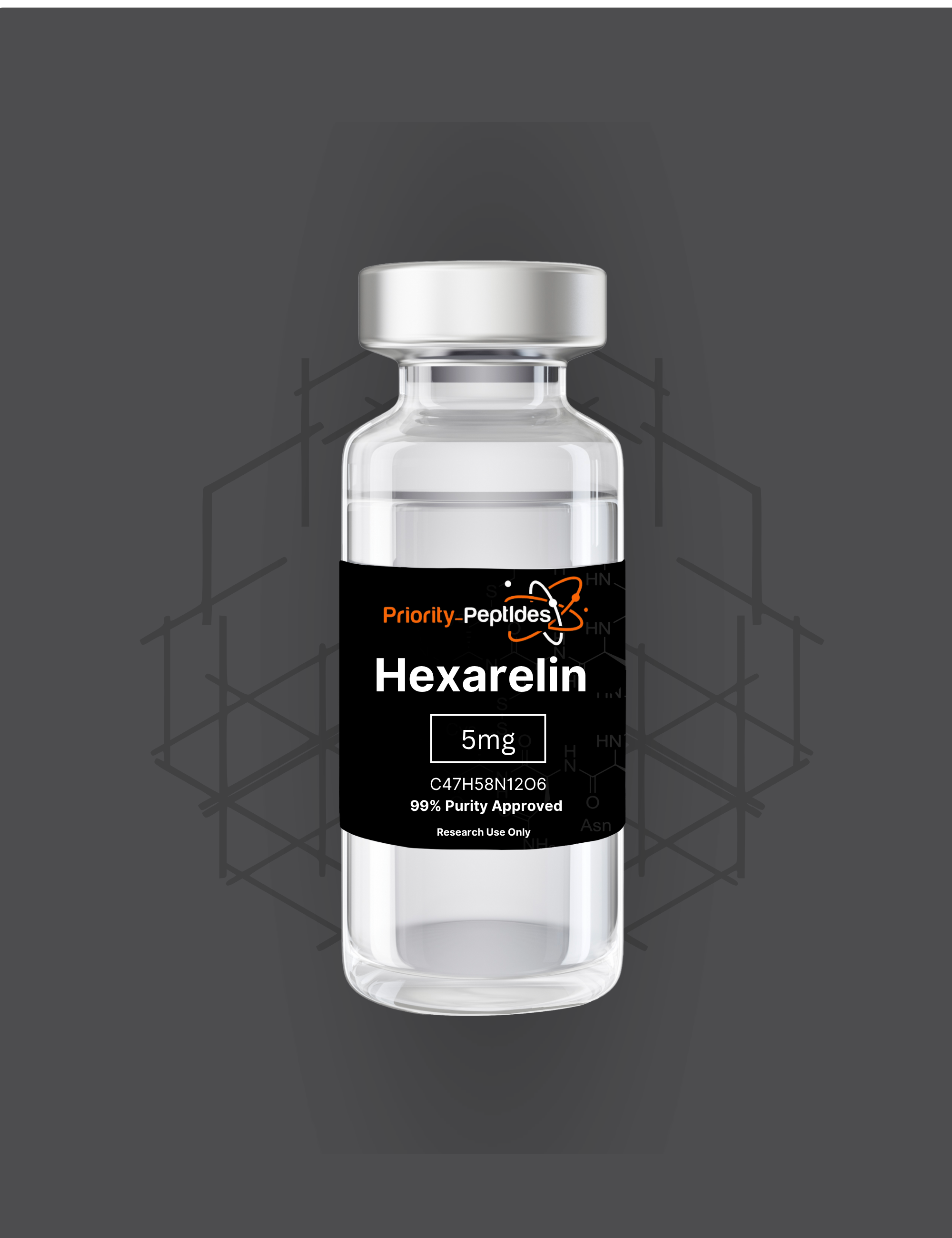
Hexarelin 5mg
$39.99
Availability: 20 in stock
Hexarelin (also known as Examorelin) is a synthetic hexapeptide developed as a potent growth hormone secretagogue (GHS), structurally related to GHRP-6 but optimized for enhanced stability and receptor affinity. It binds with high selectivity to the GHS-R1a (ghrelin receptor), stimulating growth hormone (GH) release and exerting downstream effects in metabolic, musculoskeletal, and cardiovascular systems.
Hexarelin Peptide for In Vitro Research: A Potent Growth Hormone Secretagogue with Cardioprotective and Anabolic Properties
CAS Number: 140703-51-1
Overview
Hexarelin (also known as Examorelin) is a synthetic hexapeptide developed as a potent growth hormone secretagogue (GHS), structurally related to GHRP-6 but optimized for enhanced stability and receptor affinity. It binds with high selectivity to the GHS-R1a (ghrelin receptor), stimulating growth hormone (GH) release and exerting downstream effects in metabolic, musculoskeletal, and cardiovascular systems.
With increasing interest in its role beyond endocrine regulation, Hexarelin is now extensively studied in cardiac repair, myogenesis, inflammation control, and metabolic support—making it a versatile tool for in vitro research.
Chemical and Structural Information
- Synonyms: Examorelin, HEX, GHRP-6 Analog
- Molecular Formula: C47H58N12O6
- Molecular Weight: 887.04 g/mol
- Amino Acid Sequence: His-D-2-Me-Trp-Ala-Trp-D-Phe-Lys-NH₂
- Chemical Modifications: Incorporates D-amino acids (D-2-Methyltryptophan, D-Phenylalanine) and C-terminal amidation for enhanced enzymatic resistance and biological activity.
Mechanism of Action
Hexarelin mimics endogenous ghrelin and binds to GHS-R1a receptors, triggering a series of intracellular responses:
- Pituitary Activation: Stimulates pulsatile growth hormone release directly from somatotrophs.
- Synergistic with GHRH: Enhances GH output when co-administered with GHRH analogs in experimental models.
- Cardiac Tissue Receptor Activation: Provides cardioprotective effects via GHS-R expression in myocardial and endothelial cells.
- Cellular Signaling: Engages pathways such as PI3K/Akt, mTOR, and ERK1/2, promoting anti-apoptotic, anabolic, and regenerative responses.
- Inflammatory Modulation: Reduces pro-inflammatory cytokine expression in cell-based inflammation models.
Research Applications
1. Endocrine and GH Axis Studies
- Stimulates GH secretion in vitro, with higher efficacy than GHRP-6 or ghrelin.
- Exhibits prolonged receptor responsiveness with lower desensitization risk.
- Used to investigate feedback mechanisms involving IGF-1 and somatostatin.
2. Cardiovascular Protection
- Reduces myocardial cell death in ischemia-reperfusion models.
- Prevents cardiac fibrosis and enhances ventricular performance.
- Investigated for potential in heart failure and post-MI repair protocols.
3. Muscle Growth and Tissue Repair
- Enhances myoblast proliferation and differentiation via mTOR signaling.
- Supports skeletal muscle regeneration and recovery in injury models.
- Promotes connective tissue remodeling and tendon healing.
4. Bone Metabolism
- Stimulates osteoblast activity and mineralization.
- May influence RANKL/OPG expression to support bone density.
5. Anti-Inflammatory and Metabolic Studies
- Reduces secretion of IL-6 and TNF-α in in vitro inflammation models.
- Enhances insulin sensitivity and lipid oxidation in hepatic and adipose cell cultures.
Future Research Directions
- Development of Hexarelin analogs with tissue-specific targeting (e.g., cardiac-selective GHS-R ligands).
- Exploration of topical and intranasal delivery platforms for localized regenerative effects.
- Combination studies with peptides such as CJC-1295, IGF-1, and NAD+ boosters for multi-modal in vitro protocols.
- Investigation into central nervous system effects including cognitive performance, mood regulation, and neuroinflammation.
References
- Bodart G. et al. (2002). Cardioprotective effects of growth hormone-releasing peptides in ischemia/reperfusion models. Cardiovascular Research, 55(2), 280–290. https://pubmed.ncbi.nlm.nih.gov/12177156/
- Locatelli V. et al. (1999). GHRP-6 and Hexarelin protect the heart from ischemic injury in rats. Endocrinology, 140(7), 3031–3036. https://academic.oup.com/endo/article/140/7/3031/2986517
- Ghigo E. et al. (2001). Growth hormone-releasing peptides. European Journal of Endocrinology, 145(6), 703–711. https://eje.bioscientifica.com/view/journals/eje/145/6/703.xml
Product Specifications
- Form: Lyophilized powder
- Purity: ≥ 98% (HPLC verified)
- Solubility: Soluble in sterile water or 0.9% saline
- Storage: Store at -20°C, protected from moisture and light
- Stability: Stable for 24 months if stored properly
Disclaimer
This product is intended for research purposes only. It is not approved for human or veterinary use, nor is it intended for clinical, diagnostic, or therapeutic applications. All research must comply with applicable local laws and institutional guidelines. Misuse of this compound for human consumption is strictly prohibited.