
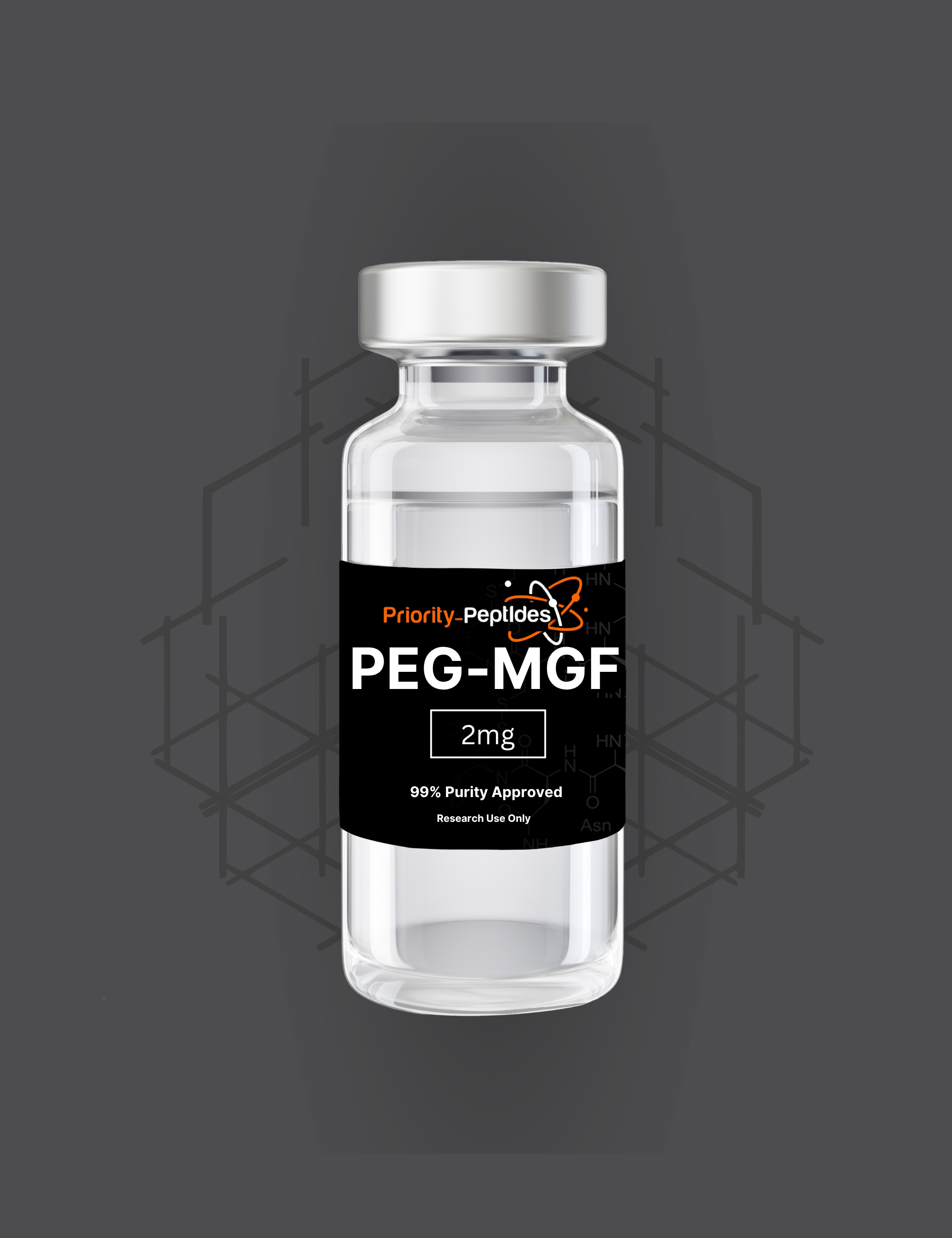
PEG-MGF 2mg
$44.99
Availability: 5 in stock
PEG-MGF (Pegylated Mechano Growth Factor) is a chemically modified, peptide-based growth factor derived from the IGF-1 (Insulin-like Growth Factor-1) family. It is engineered via pegylation (attachment of polyethylene glycol, PEG) to enhance stability, solubility, and half-life, making it highly suitable for in vitro research into regenerative medicine, muscle hypertrophy, and cellular proliferation. PEG-MGF specifically stimulates muscle cell growth, regeneration, and repair processes, and is extensively used in laboratory experiments to elucidate mechanisms underlying tissue regeneration, hypertrophy, and cellular response to injury.
PEG-MGF: A Peptide Growth Factor for In Vitro Cellular Regeneration and Muscle Growth Studies
What is PEG-MGF?
PEG-MGF (Pegylated Mechano Growth Factor) is a chemically modified, peptide-based growth factor derived from the IGF-1 (Insulin-like Growth Factor-1) family. It is engineered via pegylation (attachment of polyethylene glycol, PEG) to enhance stability, solubility, and half-life, making it highly suitable for in vitro research into regenerative medicine, muscle hypertrophy, and cellular proliferation. PEG-MGF specifically stimulates muscle cell growth, regeneration, and repair processes, and is extensively used in laboratory experiments to elucidate mechanisms underlying tissue regeneration, hypertrophy, and cellular response to injury.
Chemical Structure & Exact Sequence
Amino Acid Sequence (Applicable to IGF-1Ec / MGF derivates):
(Note: The following is the amino acid sequence for the native MGF region, the pegylation is a chemical modification)
His-Gly-Pro-Ser-Ser-Cys-Gly-Glu-Xxx-Xxx-Xxx (C-terminal extension, varies by sequence)
(Note: The specific peptide sequence of PEG-MGF is based on the IGF-1Ec (Mechano Growth Factor) isoform, with pegylation attached to increase stability and circulation time.)
Chemical Modifications:
- PEGylation: Attachment of polyethylene glycol (PEG) at specific sites (often at the N-terminus or lysine residues) to:
- Increase peptide stability against proteolytic degradation
- Prolong serum half-life, reducing dosing frequency
- Improve solubility in aqueous media
- Other Modifications: May include terminal acetylation or methylation, depending on synthesis parameters.
CAS Number:
- 108174-48-7
Molecular Formula & Weight:
- Dependent on PEG size and peptide sequence; typical PEG-MGF molecules have increased molecular weight due to PEG attachment.
Mechanisms of Action
PEG-MGF exerts its biological effects primarily through:
- IGF-1 Receptor Activation:
Binds to the IGF-1 receptor (IGF-1R), stimulating intracellular pathways like PI3K-AKT and MAPK, promoting cellular proliferation and differentiation, especially in muscle cells and stem cells.
- Muscle Cell Regeneration & Hypertrophy:
Facilitates satellite cell activation, muscle fiber growth, and myoblast proliferation, making it useful for in vitro studies of muscle regeneration.
- Protein Synthesis & Cellular Growth:
Upregulates pathways involved in protein synthesis, supporting tissue repair and hypertrophic growth.
- Anti-Apoptotic & Cytoprotective Effects:
Enhances cell survival signals, reduces apoptosis, and promotes mitochondrial health under stress conditions.
- Extended Activity via Pegylation:
Pegylation ensures prolonged circulation and sustained receptor engagement, beneficial in long-term or high-frequency in vitro studies.
In Vitro Research & Applications
- Muscle Regeneration & Hypertrophy:
Analyzing satellite cell activation, myogenic differentiation, and hypertrophic growth in cell cultures.
- Stem Cell Expansion:
Supporting stem cell proliferation and differentiation toward myogenic lineages.
- Tissue Repair:
Modeling wound healing and regenerative responses in tissue engineering.
- Metabolic & Cytoprotective Studies:
Understanding mitochondrial effects, anti-apoptotic properties, and cellular resilience.
Future Research & Developmental Directions
- Mechanistic Elucidation:
Further investigations will clarify receptor binding dynamics, intracellular signaling, and gene expression modulation.
- Dose Optimization:
Determining ideal concentrations and dosing protocols to maximize regenerative and hypertrophic effects in vitro.
- Combination Protocols:
Studying synergistic effects with other growth factors, cytokines, or biomaterials for tissue engineering.
- Long-Term Efficacy & Safety:
Evaluating stability, activity duration, and cellular toxicity over extended cellular culture periods.
- Translational Research:
Moving insights from in vitro to in vivo, developing therapeutic strategies for muscle atrophy, injury, and degenerative disorders.
References & Further Reading
(Note: As this is a research peptide, references are pending publication data; relevant materials include)
- [In Vitro Muscle Regeneration & IGF-1 Derivatives]
- [Mechanistic Studies on Pegylated Growth Factors]
- [Innovations in Peptide Delivery & Stability]
Disclaimer
This product is intended for research purposes only. It is not approved for human or veterinary use, nor is it intended for clinical, diagnostic, or therapeutic applications. All research must comply with applicable local laws and institutional guidelines. Misuse of this compound for human consumption is strictly prohibited.