
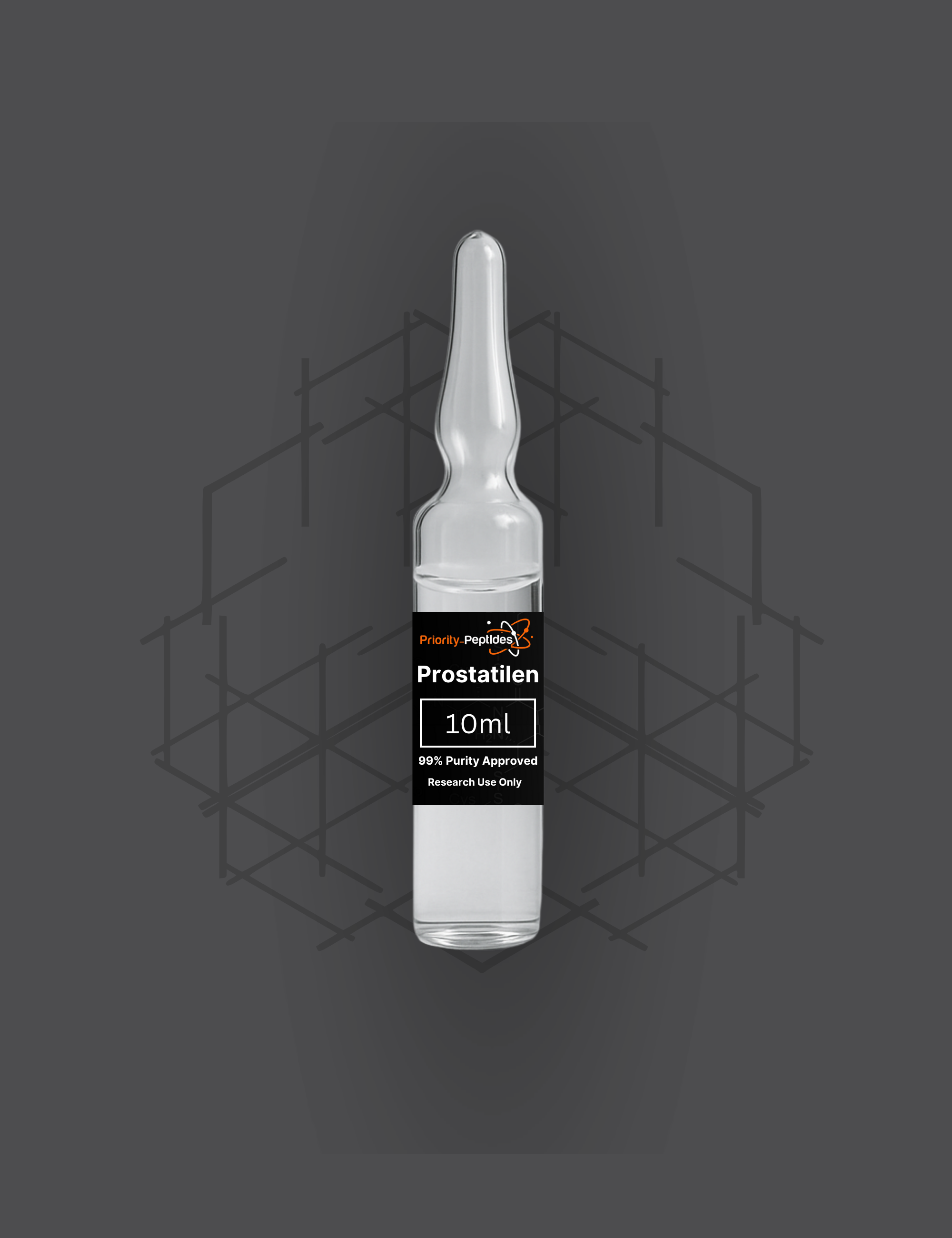
Prostatilen – Kit of 10 5ml Ampules
$149.99
Availability: 48 in stock
Prostatilen is a prostate-derived bioregulator peptide complex, originally developed in the Soviet Union, and remains widely researched in Eastern European medical science. It is classified as a Cytogen—a short peptide fragment isolated from the prostate gland of young bulls (Bos taurus) using mild acid hydrolysis. As a tissue-specific peptide bioregulator, Prostatilen selectively targets the prostate and associated pelvic tissues, modulating cellular function, immune response, and local microcirculation.
Prostatilen: A Prostate-Specific Bioregulator Peptide Complex for In Vitro Urogenital Research
What is Prostatilen?
Prostatilen is a prostate-derived bioregulator peptide complex, originally developed in the Soviet Union, and remains widely researched in Eastern European medical science. It is classified as a Cytogen—a short peptide fragment isolated from the prostate gland of young bulls (Bos taurus) using mild acid hydrolysis. As a tissue-specific peptide bioregulator, Prostatilen selectively targets the prostate and associated pelvic tissues, modulating cellular function, immune response, and local microcirculation.
Primarily researched for its effects on benign prostatic hyperplasia (BPH), chronic prostatitis, and male reproductive health, Prostatilen has demonstrated anti-inflammatory, immunomodulatory, and trophic effects in in vitro and in vivo studies. Its utility in peptide therapy and regenerative urology has positioned it as a model compound for prostate-specific peptide signaling.
Chemical and Molecular Information
- Name: Prostatilen (also known as Prostatilenum or Prostatylin)
- Type: Natural organ-derived peptide complex
- Source: Extracted from bovine prostate tissue
- CAS Number: Not assigned for the full complex (mixture of peptide fragments)
- Molecular Weight: Approx. 800–10,000 Da (heterogeneous fraction)
- Structure: A peptide blend consisting of short amino acid chains (di-, tri-, and tetrapeptides) rich in lysine, glutamate, alanine, glycine, and aspartate
Amino Acid Composition and Sequence
Prostatilen does not have a single defined sequence because it is a natural extract composed of a heterogeneous mixture of oligopeptides. However, the active fragments generally include short peptide chains (2–4 amino acids) shown to exert tissue-specific regulatory effects.
Example peptide fragments identified:
- Lys-Glu (Lysine–Glutamic Acid)
- Ala-Glu-Asp (Alanine–Glutamic Acid–Aspartic Acid)
- Gly-Glu (Glycine–Glutamic Acid)
These fragments are believed to function as peptide epigenetic regulators, modulating gene expression in prostate epithelial and stromal cells.
Chemical Modifications
-
- No synthetic modifications
- Extracted via mild acid hydrolysis
- Preserved in a lyophilized form for increased shelf-life and stability
- May be administered in injectable form for preclinical animal studies or reconstituted for in vitro assays
Mechanism of Action
Prostatilen acts via multiple well-characterized pathways:
- Tissue-Specific Regulation
Selectively accumulates in prostate tissue and modulates metabolic activity, gene expression, and regeneration of epithelial and stromal structures.
- Anti-Inflammatory Effects
Reduces the synthesis of pro-inflammatory cytokines (e.g., TNF-α, IL-6), limits leukocyte infiltration, and suppresses oxidative stress in prostatic tissue.
- Immunomodulatory Function
Enhances the function of local immune cells, restores the balance of T-helper and T-regulatory cells, and reduces autoimmune responses associated with prostatitis.
- Angiogenic Modulation
Improves local microvascular perfusion, reduces pelvic venous stasis, and promotes endothelial repair.
- Antithrombotic Activity
Exhibits fibrinolytic and antiplatelet activity within the prostate vascular network.
Applications in In Vitro Research
- Benign Prostatic Hyperplasia (BPH): Reduces prostate volume, modulates stromal/epithelial balance, and inhibits inflammatory markers.
- Chronic Prostatitis: Modulates immune and oxidative responses in infected or inflamed prostate models.
- Male Fertility Research: Investigated for its indirect role in improving ejaculate volume, sperm motility, and epithelial secretory activity.
- Immunopeptide Studies: Serves as a model for studying short peptides that regulate organ-specific immune responses.
Scientific Research and Evidence
- Fadeev, A. A. et al. (2004):
Demonstrated significant histological improvement of prostate tissue, with reduced leukocyte infiltration and enhanced acinar structure.
Source: Russian Journal of Urology
- Khavinson, V. Kh. et al. (2011):
Included in the St. Petersburg Institute of Bioregulation’s registry of organ-specific peptides. Cited for restoring prostate epithelial cell function in aging models.
Source: Peptide Bioregulators, Volume 2 (ISBN: 9785902043941)
- Mikhaĭlov, A. V. et al. (2002):
Found improvement in urodynamic parameters and a reduction in residual urine in patients with chronic prostatitis treated with Prostatilen-based compounds.
Source: Urologiia (Moscow)
Future Research Directions
- Synthetic Analogs: Identification and synthesis of defined active fragments for reproducibility in molecular research.
- Receptor Binding Studies: Elucidating specific cell surface receptors involved in Prostatilen signaling.
- Gene Expression Analysis: Mapping transcriptional effects of individual peptide fragments in prostate-derived cell lines.
- Combination Therapy Models: Exploring synergistic effects with other tissue-specific peptides (e.g., Testagen, Thymogen, Vilon).
- Microbiome-Prostate Axis: Investigating the role of peptide signaling in bacterial prostatitis and gut-prostate immune interactions.
Disclaimer
This product is intended for research purposes only. It is not approved for human or veterinary use, nor is it intended for clinical, diagnostic, or therapeutic applications. All research must comply with applicable local laws and institutional guidelines. isuse of this compound for human consumption is strictly prohibited.